
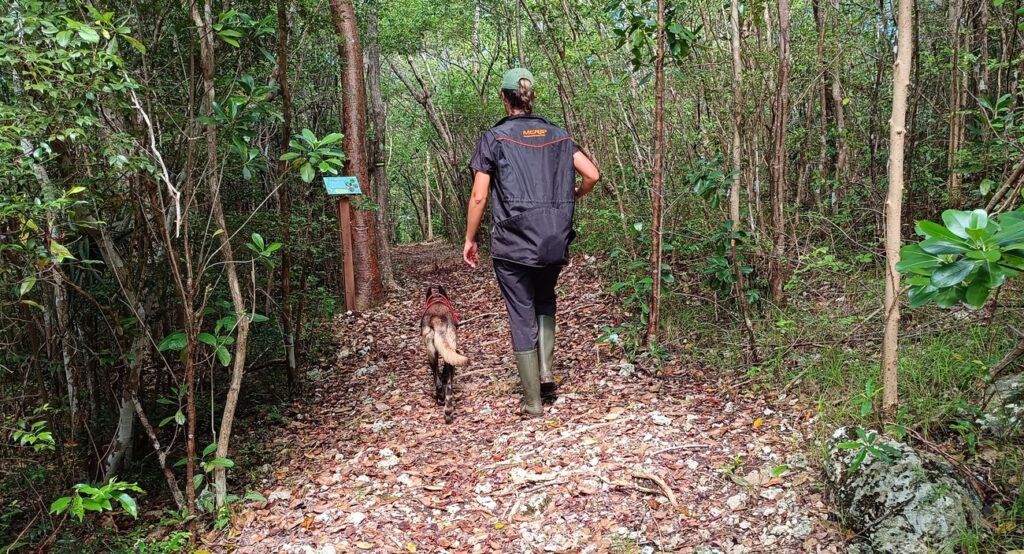
As part of its projects, Caribaea Initiative develops innovative approaches to improve data collection. Among these, the use of a detection dog makes it possible to locate cat scats in the field. After several months of training, this method is now operational.
The use of detection dogs is not limited to search and rescue or security operations. For several years, these animals have also been used in ecology and conservation biology, notably to detect rare species, nests, living individuals, or biological traces that are difficult for humans to identify.
Thanks to their exceptional olfactory abilities, dogs can rapidly and efficiently locate signs of presence, even in complex natural environments. In an insular context such as the Caribbean, where habitats can be dense and difficult to access, this approach represents a considerable asset for improving both the quality and quantity of data collected in the field.
Better understanding the diet of feral cats
In insular environments, feral cats can pose a major threat through predation to many native species. Gaining an accurate understanding of their diet is a key step in quantifying their actual impact and adapting management strategies accordingly. This is one of the objectives of the CIMBA project, which focuses on the study and management of the impact of exotic predatory mammals in the insular Caribbean.
Collecting scats in the field provides access to this information through laboratory analyses, notably using molecular approaches. However, this type of collection is often time-consuming and unpredictable when relying solely on human surveys. Integrating a detection dog trained for this task therefore aims to optimize field effort and ensure the collection of a sufficient number of samples within the timeframes required by the project.
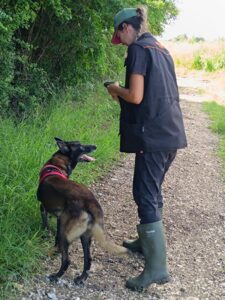
With this objective in mind, two members of the team, Sarah Lionnet (project officer) and Yuna Mélane (PhD student), were trained in search dog handling in partnership with Le Domaine Canin. At the same time, a female dog named Amat was specifically trained to recognize the scent of cat scats, under conditions progressively approaching those encountered in the field.
A method now operational in the field
Following several months of joint training of the human–dog team, Amat was subjected to an aptitude test under semi-natural conditions within a protected area in Guadeloupe.
The results of this test, designed to assess her ability to detect and mark cat scat samples placed along a transect or randomly distributed in the environment, were encouraging, with the detection of most samples within a limited search time. These performances confirm the relevance of this method for use within the framework of the project.
Although her training continues to maintain and refine her detection skills, Amat is now fully operational, and the first scat collections have already begun in the field.
An innovation serving Caribbean biodiversity
The samples collected thanks to the detection dog will feed into the analyses planned within the CIMBA project, contributing to a better understanding of the impact of exotic mammals on local biodiversity. In the long term, these results will make it possible to better design and adapt management actions, based on objective and quantified data.
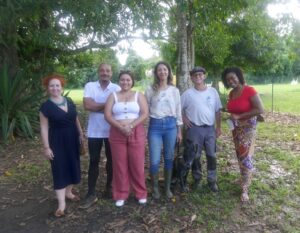
These activities are part of a broader approach developed within the CIMBA project, which goes beyond the ecological study of feral cats alone. The project also includes a component dedicated to understanding perceptions associated with these animals, through surveys conducted among protected area managers and local populations. These elements are essential for better grasping the social and cultural issues linked to cat management in insular territories.
In addition, the project includes an awareness-raising component aimed at informing the general public about the ecological and health impacts of exotic predatory mammals, and at fostering a better understanding of the management measures implemented. By combining scientific research, methodological innovation and outreach activities, the project seeks to propose management strategies that are effective, socially acceptable and sustainable for Caribbean biodiversity.